
Frank Smith Calls Dana White a ‘Shit Promoter,’ Reveals Fury vs Joshua Karaoke Bar Negotiations
Matchroom CEO Frank Smith blasts Dana White over Fury vs Joshua, reveals Brighton karaoke bar negotiations, and defends Eddie Hearn and Anthony Joshua.
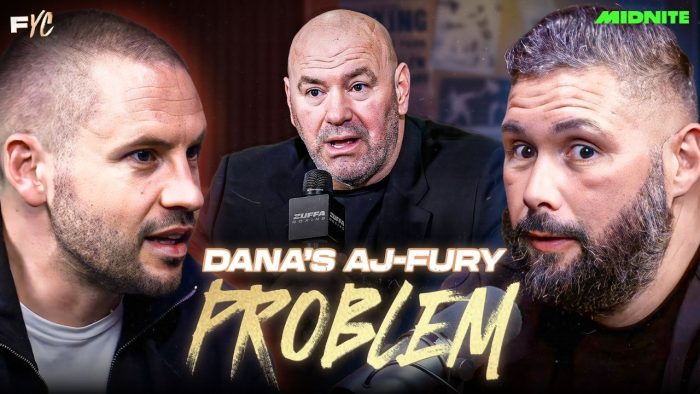
Frank Smith Blasts Dana White Over Fury vs. Joshua, Reveals Secret Karaoke Bar Negotiations and Defends Eddie Hearn
MIAMI, FLORIDA — Tension around the highly anticipated heavyweight clash between Tyson Fury and Anthony Joshua has intensified after Frank Smith, CEO of Matchroom Boxing, publicly criticized UFC figurehead Dana White, accusing him of making misleading statements about the fight and questioning his role in promoting one of boxing’s biggest events.
Speaking on Fight Your Corner, in partnership with Midnite, Smith addressed the behind-the-scenes negotiations for Fury vs. Joshua, defended longtime Matchroom chairman Eddie Hearn, and discussed the importance of loyalty between fighters and promoters.
Joined by former cruiserweight world champion Tony Bellew, Smith also revealed the unusual circumstances surrounding negotiations for the heavyweight showdown, including a four-hour meeting with representatives from SELA and legal teams inside a Brighton karaoke bar.
Frank Smith Accuses Dana White of Being Trapped in a ‘Tangle of Lies’
Smith did not hold back when discussing Dana White’s public statements about Fury vs. Joshua, particularly the UFC executive’s claims surrounding the event’s promotion and original scheduling.
The Matchroom CEO questioned why White would miss a press conference for a fight he claimed to be promoting.
“Do you think the promoter of the biggest boxing fight in recent history of the sport, right? The promoter of the fight? Would miss the press conference? And if you’re the promoter of the fight, why did you stage the press conference on the day you couldn’t make it?”
Smith suggested that White had continued defending earlier statements rather than acknowledging changes to the event.
“So, is he promoting the fight? No. But he’s stuck in this tangle of lies that he can’t get out of. So he’s just like, ‘Let me double down.'”
He pointed specifically to previous discussions about a November 20 date at Madison Square Garden and the possibility of staging the fight in the United States, neither of which materialized as originally discussed, according to Smith.
Bellew also weighed in, arguing that boxing’s promotional structure cannot be controlled by a single individual.
“One man can never run boxing. It can never be allowed to happen.”
Smith’s criticism became even more pointed when he questioned White’s promotional commitment.
“So you didn’t watch the press conference for the show you’re promoting? Fuck me, you’re a shit promoter.”
Smith went on to characterize White’s public messaging as a “propaganda machine,” suggesting that the UFC executive was unwilling to retreat from earlier positions.
The comments reflect Smith’s assessment of White’s involvement and have not been independently established as factual findings about White’s conduct.
Why Frank Smith Says Eddie Hearn’s Passion for Boxing Cannot Be Replaced
While criticizing White, Smith offered a strong defense of Eddie Hearn, highlighting the Matchroom chairman’s dedication to fighters and events at every level of professional boxing.
Smith explained that Hearn’s enthusiasm extends beyond major championship events to smaller fights featuring developing prospects.
“He loves the sport. He’s so passionate for the sport. Whether it’s a world title fight, the biggest fight in the history of the sport, or a four-rounder that no one’s ever heard of.”
Bellew echoed those sentiments, emphasizing Hearn’s detailed knowledge of the fighters competing on Matchroom cards.
“Eddie will tell you everything about every fighter on that bill, and he’ll tell you the background, the research. He’ll know every single fighter and you can’t replace a passion like that for the sport.”
Smith acknowledged that Hearn is a polarizing figure among boxing fans but argued that his commitment to the sport remains undeniable.
He also discussed the division of responsibilities within Matchroom, explaining that he and Hearn bring different strengths to the organization.
Turning his attention back to White, Smith questioned how closely the UFC executive remains involved in day-to-day operations, pointing to UFC executive Hunter Campbell’s operational responsibilities.
Those comments further illustrated Smith’s broader argument that successful boxing promotion requires direct involvement, detailed knowledge, and a genuine connection with the sport.
Tyson Fury vs. Anthony Joshua Deal Negotiated Inside a Brighton Karaoke Bar
One of the interview’s most surprising revelations involved the location of a crucial negotiating session for the Fury-Joshua fight.
According to Smith, representatives from SELA and legal teams met with him in Brighton on a Sunday evening to resolve outstanding contractual matters.
Finding a suitable meeting location proved unexpectedly difficult.
Smith explained that several restaurants and venues had already closed, forcing the group to search for somewhere they could continue discussions.
Eventually, they settled inside a karaoke bar.
“So we’ve gone and sat in the corner of this place. They’re doing karaoke out there and we’re talking about AJ Fury and what the remaining points are! And this went on for 4 hours.”
Smith said negotiations continued while other participants joined by telephone, creating an unusual atmosphere for discussions involving one of boxing’s most anticipated heavyweight fights.
“And the people on the phones are like ‘where on earth are you?’ And we’re like ‘we’re in a karaoke bar because there was nowhere else’.”
Despite the unconventional setting, Smith said the group made considerable progress during the Sunday evening meeting.
The remaining details were finalized the following afternoon, according to his account.
Smith also recalled communicating with Hearn during the negotiations.
“I was walking to the toilet going ‘Ed, I’m in a karaoke bar and it’s 11:30 on a Sunday night.'”
He joked that the circumstances would have made compelling behind-the-scenes footage for the fight’s Netflix production.
The account provides a glimpse into the negotiations required to bring Fury and Joshua together after years of speculation surrounding a potential meeting between the British heavyweight stars.
Frank Smith Addresses Controversial 2 A.M. Fury vs. Joshua Fight Time
Smith also addressed concerns surrounding the proposed late-night scheduling of the heavyweight showdown.
The Matchroom executive explained that the promotional team wanted the contest staged in the United Kingdom, although discussions had previously involved a potential American venue.
According to Smith, a U.S.-based event would have resulted in a later local evening start, making the time difference an important factor when considering broadcast arrangements.
“Ultimately for us, we wanted to make the fight in the UK. There was talk about 1:30am, but they were obviously happy to fight in the US. So, when it was in the US, it would have been at 9pm in Eastern time at least, maybe even later.”
Smith also suggested that White’s involvement had favored Fury’s interests during the negotiations.
“He said it in an interview the other day. Dana White got Tyson Fury’s visa, yeah? So Dana White is very much on Tyson Fury’s side in all of this.”
Although Smith discussed the late-night scheduling and White’s relationship with Fury, his remarks did not independently establish that the proposed start time was specifically designed to satisfy White or Fury.
The scheduling debate nevertheless highlights the competing demands involved in staging a major international boxing event, particularly when balancing the interests of fighters, promoters, broadcasters, and audiences across multiple time zones.
Anthony Joshua’s Loyalty to Matchroom Has Never Been in Doubt, Says Smith
Another major topic during the interview was Anthony Joshua’s longstanding relationship with Matchroom Boxing.
Smith praised Joshua’s loyalty and suggested that the former heavyweight world champion would be prepared to walk away from a proposed agreement if the terms were not right.
“AJ is loyal to the core, just like what Bellew was like back in the day – and he is now, but when he was fighting. Darren Barker the same. AJ would walk away tomorrow if it didn’t make sense and he went ‘I’m with you guys’.”
Bellew argued that loyalty becomes meaningful only when relationships are tested under difficult circumstances.
“You can only determine if someone’s loyal when the loyalties get tested. People can say they’re loyal, test their loyalties first.”
Smith explained that Matchroom places significant value on fighters who trust their promotional teams and maintain long-term professional relationships.
He also noted that Joshua had received lucrative offers at different stages of his career but ultimately benefited financially from remaining with Matchroom.
“AJ got offered loads of money at times in his career, but ultimately in the long run got a deal from us that was sensational in terms of like the money. He’s one of the highest paid athletes, combat athletes in sport ever.”
Smith’s comments reinforced his belief that strong relationships between fighters and promoters can produce benefits extending beyond individual contracts or events.
Tony Bellew Highlights Katie Taylor’s Loyalty and Matchroom’s Fighter-First Approach
Bellew also referenced former undisputed lightweight champion Katie Taylor while discussing the importance of loyalty and trust in professional boxing.
He described Taylor’s relationship with Matchroom as another example of a fighter maintaining strong ties with her promotional team despite receiving opportunities elsewhere.
“Katie Taylor was obviously loyal to the core. They allowed Katie Taylor to come to them and told them about an offer that she was placed from MVP or whatever it was. They’ve done what’s best for Katie Taylor. How many promoters are willing to do that? I don’t know many.”
The discussion reflected a broader theme throughout the interview: the importance of transparency, communication, and mutual trust in an industry frequently characterized by competing promotional and financial interests.
Fury vs. Joshua Rivalry Extends Beyond the Ring as Promotional Tensions Escalate
The latest comments from Frank Smith add another dimension to the build-up surrounding Tyson Fury vs. Anthony Joshua.
While the heavyweight showdown remains the central attraction, the relationships between Matchroom Boxing, Dana White, and other stakeholders have become a prominent part of the event’s surrounding narrative.
Smith’s criticism of White, his defense of Hearn, and his account of negotiations in Brighton demonstrate the complexity of organizing a fight involving two of Britain’s most recognizable boxing stars.
With promotional disagreements, broadcast scheduling, and contractual negotiations generating headlines, the discussion surrounding Fury vs. Joshua extends well beyond what will happen inside the ring.
For Smith, however, the central message remains the importance of experienced boxing promoters, strong fighter relationships, and the dedication required to deliver major events.
Frank Smith was speaking on Fight Your Corner, in partnership with Midnite.
FightBook MMA will continue covering Tyson Fury vs. Anthony Joshua, including fight-week developments, official weigh-in results, and fight-night updates.

Roberto Villa is the CEO, Founder, Executive Writer, and Senior Editor of FightBook MMA. Has a passion for Combat Sports and is also a podcast host for Sitting Ringside. He’s also a former MMA fighter and Kickboxer. He’s also the main photographer for the 4CornersMafia Car Club.